

What's New
News & Announcements
-
Sanghamitra Jayant, a PhD student at SPP at IIT-Delhi, has recently has received a Certificate of Appreciation from the Indian Energy Storage Alliance as part of the “Women leaders driving energy sector in India” for outstanding contributions to the Indian Energy Industry and for her leadership and being a role model for women in the energy sector.
We are proud to have Sanghamitra among our doctoral students!
Read more about her work here.
-
In the Indian public policy context, public bureaucracy can substantially alter public policy outcomes through good or bad governance. Our last academic seminar this term will be delivered by Anustubh Agnihotri, who will speak to this subject.
Please see details of the seminar below and join us for this event.
Speaker: Anustubh Agnihotri
Date: 21st April
Time: 5-6:30 pm
Venue: LH 602Title: Organizational Rules, Bureaucratic Preferences, and Local State Capacity
Abstract:State capacity, or the ability of the bureaucracy to effectively deliver services to its citizens, varies significantly at the local level. While in some jurisdictions, citizens experience bureaucratic delays, in other jurisdictions, the same bureaucracy can be responsive. How should we understand these spatial differences in local state capacity? I argue that we need to closely examine the politics within the state. Specifically, I look at the role of politics behind the transfers of Tehsildars – mid-level bureaucrats in the land bureaucracy who deliver crucial services to citizens – in creating differences in the extent to which jurisdictions remain unoccupied at the local level. I show that Tehsildars have strong locational preferences and regularly lobby against organizational orders relocating them over long distances or placing them in jurisdictions further away from their homes. These lobbying efforts result in less preferred jurisdictions remaining vacant for a longer duration. Further, the likelihood of state absence due to bureaucratic lobbying efforts mirrors historical patterns of development, less developed regions with lower bureaucratic representation experience a higher period of absence. These findings have important implications for how we think about determinants of the quality of last-mile delivery of public services. I suggest that aligning organizational processes with the preferences of individual bureaucrats can act as an important policy level for shaping the quality of local governance.
Brief Bio:Anustubh Agnihotri is an Assistant Professor of Political Science at Ashoka University. He finished his Ph.D. in Political Science at The University of California at Berkeley and holds a Masters in Public Policy and a Masters in Electrical Engineering from The University of Texas at Austin as well as a Bachelors in Electronics and Telecommunications from Pune University. His research engages with questions around bureaucratic politics and citizen-state interactions and his papers are published in journals like World Development and Governance. He also studies how new technologies are adopted and scaled in resource-poor contexts and was part of an interdisciplinary team effort to put together an open source textbook in the field of Development Engineering.
You can find more information about Anustubh on his website https://anustubhagnihotri.com/ -
We are delighted to share that our next speaker in the SPP Policy and Practice Seminar series is Mr. Harish Damodaran, National Rural Affairs & Agriculture Editor of The Indian Express and Senior Visiting Fellow at the Centre for Policy Research, New Delhi.
Title: From Green Revolution 1.0 to Green Revolution 2.0Speaker: Mr.Harish Damodaran
Date: 19th April
Time: 12-1:30 pm
Venue: LHC 623
Abstract:Mr. Damodaran will speak about Green Revolution 2.0. How it is different from Green Revolution 1.0. What are the challenges faced by Green Revolution 2.0 vis-a-vis the challenges under Green Revolution 1.0?
Brief bio:
Mr. Damodaran has been a journalist with over three decades of experience as a reporter and editorial analyst with the Press Trust of India (1991-94), The Hindu Business Line (1994-2014) and The Indian Express (since 2014), he is also the author of two books: 'India's New Capitalists: Caste, Business and Industry in a ModernNation'(https://link.springer.com/book/10.1057/9780230594128) which won the Ramnath Goenka Excellence in Journalism Award under the Books (Non-Fiction) category in 2008 and 'Broke to Breakthrough: The Rise of India's Largest Private Dairy Company' (https://penguin.co.in/book/broke-to-breakthrough/) which won the Gaja Capital Business Book Prize for 2022.
-
We will have Dr. Sanjay Misra who works at the DST, presenting in our Policy and Practice seminar series this coming Wednesday at noon. I hope many of you will attend the seminar, details of which are below.
Speaker: Dr Sanjay Mishra
Date: 5 April, Wednesday
Time: 12- 1:30 pm (IST)
Venue: LH 623
Title: Public policy in real world: Some reminiscences from science ministry
Abstract:
This lecture will discuss how new programs or interventions are conceived, designed, launched and implemented with selected case studies from the speaker’s real world experience at the Ministry of Science & Technology, Govt of India. It focuses on two thematic areas, firstly – programs for improving the innovative and critical thinking among school students, and secondly – programs for improving the gender parity in science & technology sector. Furthermore, some “experiments” in program-delivery which have given positive results during program implementation are shared along with with some challenging areas. The lecture tries to demystify, based upon own experience, underlying reasons of success of programs in certain states, districts or institutions
Brief bio:
Dr Sanjay Mishra has studied DPhil in Biomedical Engineering at Oxford University, authored about two dozen research papers, book chapters in areas of biomechanics, Finite Element Modelling, higher education and teaching learning. He has worked in academia in India, the USA and Australia for more than 20 years. After return to India in 2012 he has joined Department of Science & Technology (DST) as Advisor and moved to Department of Biotechnology (DBT) in 2021 as Senior Advisor. He has also contributed opinion and research pieces to Economic & Political Weekly, Times Higher Education THE UK. -
-
-
We will have Dr. Ashok Sreenivas from the Prayas Energy Group present a seminar to us this Wednesday at noon. Prayas is one of the best examples in the country for how independent policy analysis can make a difference to practice; they are highly respected by the government and academics alike, and have paved the way for constructive citizens' engagement, especially in the power sector.Speaker: Dr. Ashok Sreenivas
Date: 22nd March, Wednesday
Time: 12- 1:30 pm (IST)Venue: LH 213Title: How nerds engage effectively with policy processes?: a case study of Prayas (Energy Group)Abstract:
Prayas was founded by a bunch of professionals who wanted to bring their expertise to use for social good. The Energy Group of Prayas uses policy research and engagement as the means to do so in the broad field of energy, sustainability and climate change. It comprises a set of people with professional degrees and expertise who have a social bent. We undertake interdisciplinary research on policy and regulatory matters to promote public interest in the energy sector with a focus on electricity. The talk will provide a brief overview of Prayas (Energy Group) and dive into a few examples to illustrate PEG's approach to policy engagement and some impacts thereof. The objective of the seminar is to explore possible collaborations between PEG and students and faculty at IITD.Bio:
Ashok Sreenivas is the Group Coordinator at the Prayas (Energy Group). Ashok has been associated with Prayas since 2007. Over this period, he has worked in various areas relevant to energy policy such as oil-and-gas, transport, coal, climate change, energy security, energy access and energy modelling. He is currently interested in issues around energy transition and its implications for policy, institutions and equity. In particular, he focuses on phasing down coal in a manner consistent with India's requirements while enabling those affected in this process to adopt other, fulfilling livelihoods. He is also interested in developing energy models to answer some interesting and relevant policy questions, and enhancing usage of non-polluting cooking fuels. -
The engagement between Mr. Alok Rajan and the students of the School of Public Policy (SPP) at the Indian Institute of Technology Delhi (IITD) focused on the projects undertaken by the speaker and the intersection of public policy students in his projects.
During the discussion, Mr. Rajan, who is the Program Officer – State Capacity and Public Finance at BMGF, outlined the criteria used to select projects and the different types of interventions that can be done. The session also delved into the topic of health system design, where Mr. Rajan highlighted the importance of design thinking and the need to focus on transversal issues.
The engagement concluded with an interactive Q&A session where the students had the opportunity to ask Mr. Rajan various questions related to BMGF's projects and their potential roles as public policy professionals. Mr. Rajan patiently addressed the students' queries, providing them with valuable insights and perspectives.
Overall, the engagement provided a valuable learning experience for the students, as it exposed them to the workings of one of the world's largest philanthropic organizations and the potential avenues for making a meaningful impact in the field of public policy.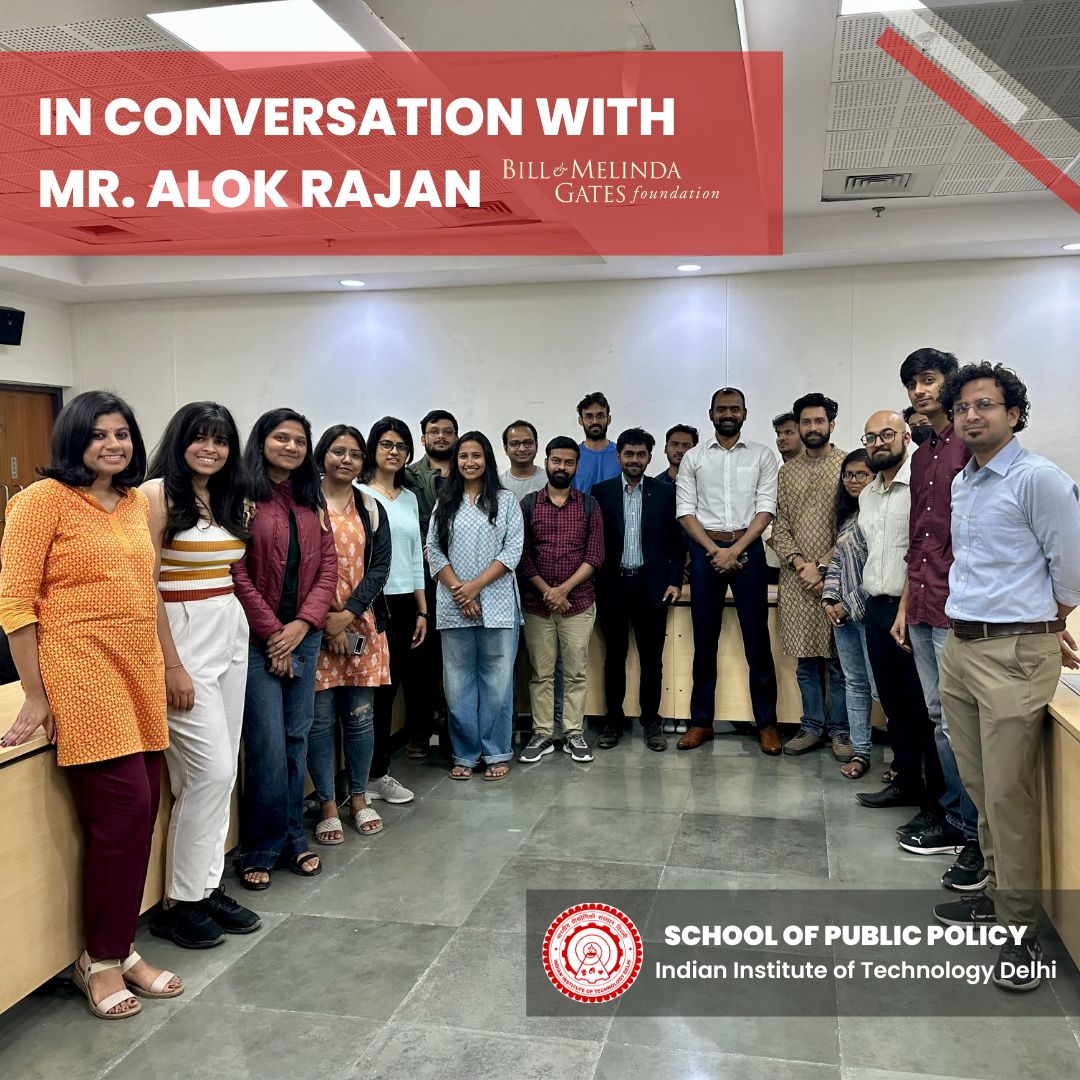
-
Here's a wrap up of the peer-reviewed publications from our faculty members in the last 3 months.
Suma Athreye, Abhijit Sengupta, Oladimei J. Odentunde. "Academic Entrepreneurial Engagement with Weak Institutional Support: Roles of Motivation, Intention and Perceptions ". Studies in Higher Education, March 2023
Link: http://dx.doi.org/10.1080/03075079.2023.2184789
Abstract: The paper investigates the potential impact of entrepreneurial motivation, entrepreneurial intention and academic researchers’ perceptions of departmental and university support on academic entrepreneurial engagement in a context of weak or missing institutional support. A conceptual model linking motivation, intention and perceptions to entrepreneurial engagement is developed and tested on primary data collected from academic researchers in Nigeria. We find that while entrepreneurial motivation strongly influences entrepreneurial intentions of researchers, the link between intention and engagement is weaker. Perceptions of departmental entrepreneurial orientation positively mediates a significant proportion of the latter link. In contrast, perceptions about the university’s supportive framework and facilities play a relatively weaker role. Subsequently, the implications of these findings on policies and incentives for entrepreneurial academics and universities in weak institutional settings are explored.
Nandana Sengupta, Vidya Subramanian, Anwesh Mukhopadhyay, Arul Scaria. "A Global South perspective for ethical algorithms and the State". Nature Machine Intelligence , Feb 2023
Link: https://rdcu.be/c6zPu
Abstract: We explore the intersection between algorithms and the State from the perspectives of legislative action, public perception and the use of AI in public administration. Taking India as a case study, we discuss the potential fallout from the absence of rigorous scholarship on such questions for countries in the Global South.
Yuno Tajima, Shizuka Hashimoto, Rajarshi Dasgupta, Yasuo Takahashi. "Spatial characterization of cultural ecosystem services in the Ishigaki Island of Japan: A comparison between residents and tourists". Ecosystem Services, Feb 2023
Link: https://www.sciencedirect.com/science/article/pii/S2212041623000128
Abstract: Culturall Ecosystem Services (CES) are non-material benefits that are indispensable for the health and well-being of communities. CES are often spatially explicit and fluctuate according to the knowledge, beliefs, and perception of users of the location. Therefore, understanding the spatial patterns of CES perceived by people from different backgrounds is important for decision-makers to carry out proactive landscape planning. In this study, we investigated the differences in the perception of CES between residents and tourists on Ishigaki Island, Japan. The study employed a Public Participation Geographic Information System (PPGIS) approach to spatially present the respective perceptions of residents and tourists regarding six types of CES, namely recreational, therapeutic, educational, spiritual, aesthetic, and historic CES, that are recognized as key contributors to human health and well-being. For data collection, we employed a combination of household-level postal surveys and in-person questionnaire surveys targeting residents (n = 410) and tourists (n = 102), respectively. A series of statistical and spatial analyses was conducted on the survey results to understand the influence of the duration of residence and the frequency of visits in shaping the perceptions of CES, as well as the relationship between perceived CES and land-use types. This included the contribution of protected areas to the delivery of CES. The results showed that the average number of locations indicated by residents was significantly higher than that indicated by the tourists, resulting in density maps with distinct spatial patterns. In particular, the spatial pattern of CES identified by tourists was considerably simpler than that recognized by residents and centered on two popular tourist spots. As per the elements of landscapes and seascapes, the perception of “aesthetic,” “recreational,” “therapeutic,” and “educational” CES by residents was associated with “forest” and “sea” and that of “spiritual” and “historic” was associated with “forest” and “farmland.” In contrast, the CES perception of “recreational,” “educational,” “therapeutic,” “aesthetic,” and “historic” by tourists was associated with “sea” and “forest.” “Spiritual” CES was associated with “forest” and “sea.” Lastly, a higher proportion of “aesthetic” CES locations were identified within protected areas compared to outside the areas. Overall, our findings revealed that residents and tourists perceive and appreciate the numerous CES arising from landscapes and seascapes of the island differently. This indicates a possible trade-off resulting from land or sea developments to the benefit among stakeholders, for example, tourists. Hence, to sustain CES that underpin equitable health and well-being benefits, spatial planning should consider the different perceptions of stakeholders, particularly of residents and tourists, regarding CES types and locations.
Pooja Prasad, Annelieke Duker, Charlotte de Fraiture, Pieter van der Zaag. "Irrigation development under uncertainty: A call for adaptive investment pathways". Environmental Science and Policy, Jan 2023
Link: https://doi.org/10.1016/j.envsci.2022.11.017
Abstract: There is an urgent need in sub-Saharan Africa (SSA) to enhance irrigation access to meet the challenges of growing population and climate risk. To achieve this, big investments are currently planned in large irrigation infrastructure. We believe there is danger in following this conventional approach, which requires big lumpsum investments, locking large capital into projects that do not adapt to deep uncertainties from climatic or socio-political factors. Instead, in this Perspective article, we propose an alternate “adaptive investment pathways” (AdIP) approach for planning stepwise investments towards desired objectives, implemented progressively depending on how the future unfolds, in order to gain flexibility. AdIP extends the adaptation pathways concept, which refers to a sequence of actions to be taken in response to a changing reality, and applies it to the context of development under uncertainty. Monitoring and learning is at the heart of this approach, which ensures that the plan adapts as new knowledge becomes available. Thus, AdIP internalizes risk and reduces chances of failures. For financial institutions backing development projects, following a pathway of smaller de-centralized investments lowers risk and incorporates a learning approach that allows re-thinking and adapting along the path. We illustrate the AdIP approach using the case of ephemeral sand river based small-scale irrigation in the drylands of SSA. We conclude that in face of deep uncertainties, the path to successful irrigation development in SSA requires a shift from making few large upfront investments in large-scale projects to making large numbers of smaller investments that assure flexibility.
Krishna, H., Kashyap, Y., Dutt, D., Sagar, A.D. and Malhotra, A. "Understanding India’s low-carbon energy technology startup landscape". Nature Energy, Dec 2022
Link: https://www.nature.com/articles/s41560-022-01170-y
Abstract: Low-carbon energy technology (LCET) startups could play a key role in accelerating India’s decarbonization. Yet, our understanding of the LCET startup landscape and what shapes it remains low. Here we provide an analysis of the Indian LCET startup landscape to fill this gap. Our descriptive analysis of quantitative data on investment and patenting activities of LCET startups from 2010 to 2020 and qualitative data from 25 semi-structured interviews shows a substantial increase in investment and patenting activity, particularly after 2017, driven in large part by market-creation measures undertaken by the Indian government. However, there are large differences between LCET startups in different sub-sectors and core value-creating activities. Our findings suggest that the level of technological capabilities moderates the relationship between market-creation measures and innovation outcomes—thus highlighting the need to complement market-creation policies with long-term measures to strengthen technological capabilities. Furthermore, we propose a research agenda to improve our understanding of LCET entrepreneurship in developing economies.
-
The School of Public Policy is pleased to announce the first seminar in Policy and Practice Series. This first seminar will be online, and we invite all interested students and faculty to join us.
Title: Multilateral Climate Finance: Some Lessons from the Green Climate FundSpeaker: Dr. Archi Rastogi
Date: 1st March 2023, Wednesday
Time: 12- 1:30 pm
Link:https://meet-iitdelhi.webex.com/meet-iitdelhi/j.php?MTID=m01fd7d083ae0816f380ccebcb425068c
Abstract:Climate has emerged as a key global concern, and with this there is a proliferation of climate finance institutions. Current estimates suggest that global climate finance flows in 2019/2020 were more than USD 600 million annually, while still only a tenth of the global needs. How is this global climate finance flow organized? How is it governed? This introductory webinar will provide an introduction to global climate finance architecture and flows. Focusing then on public finance more closely, it will identify some current trends in multilateral climate finance/ development finance. Finally, the webinar will take a closer look at the case of the Green Climate Fund and identify some lessons learnt for multilateral climate finance.
Bio:Archi Rastogi, Ph.D., is currently at the Independent Evaluation Unit (IEU) of the Green Climate Fund (GCF), the world’s largest multilateral climate fund. Archi has worked at the interface of science and decision-making, and most recently through policy evaluations. At the GCF, he is a task lead for the development of the evaluation policy for the institution, providing a clear space for the use of evidence in policy making. -
The School of Public Policy is hosting a seminar on "Subaltern frontiers: agrarian city-making in Gurgaon" by Tom Cowan (University of Nottingham, UK) on Friday, the 24th of February 2023. See details about the talk, and the speaker bio below. We look forward to seeing you there!Title: Subaltern frontiers: agrarian city-making in GurgaonSpeaker: Tom Cowan (University of Nottingham, UK)
Venue: LH 213Date and time: 24 February 2023 (Friday), 5 - 6.30 pm
Abstract:Over the past twenty years, many parts of rural and peri-urban India have witnessed remarkable transformation as politicians, planners and the private sector have converged to refashion land for real estate investment, industrial development and urban expansion. While to some extent this 'real estate turn' conforms with broader patterns of urbanization in many parts of the world, this seminar discusses the particularly agrarian and uncertain trajectories of extended urbanisation in contemporary India. Drawing on ten years of fieldwork in the city of Gurgaon, once considered a vanguard of a new urban India, the seminar will discuss the ways the rapid urbanisation of the Haryana countryside has been articulated through agrarian institutions, actors and histories. Counter to scholarship that advances a theory of planetary dispossession and enclosure at the forefront of a global urbanisation, I argue that in Gurgaon it is the endurance of nonprivatized _abadi _lands that have brokered capital's access to rural land, it is those same village-monopolies that have fired agriculturalists into speculative rentier economies pushing at the city's boundaries; and it is agrarian institutions, technologies and logics that have unevenly aggregated and converted land into an investible asset. The implication of the agrarian world in urban expansion, this paper will argue, not only facilitates capitalist urban expansion but frequently stalls, augments and obstructs such expansion, producing quite other urban geographies. Attention to the articulation of the agrarian in urban spatial production draws us into the uncertain political grounds upon which urban expansion is waged.
Bio:Tom Cowan is an assistant professor in geography at the University of Nottingham. His research interests focus on the geographies of extended urbanisation, property making and labour politics. His book "Subaltern frontiers: agrarian city-making in Gurgaon" was published by Cambridge University Press in 2022. He is currently conducting research on property digitization in peri-urban Delhi and Gurgaon. -
We are delighted to host a seminar by SoPP's own Prof. Suma Athreye on the topic "Inclusive Innovation for the Bottom of Pyramid customer: It's a Matter of Survival!" on Tuesday, the 21st of February 2023, at 5pm. See details about the talk below. We look forward to seeing you there!
Title: Inclusive Innovation for the Bottom of Pyramid customer: It's a Matter of Survival!Speaker: Suma Athreye, Professor, SoPP, IIT Delhi; Link to bio
Venue: LH 621Date and time: 21 February 2023 (Tuesday), 5-6.30 pm
Abstract: The private sector provision of inclusive innovations to "base of the pyramid" (BoP) communities, offers large social rewards but also poses varied challenges for private sector actors such as multinationals, domestic firms and non-corporates. Our paper develops a framework mapping out the challenges encountered by firms introducing a new inclusive innovation product during the design, production, marketing, adoption, and diffusion phases (DePMAD framework). We validate the framework, by examining the problems encountered by 51 (published) case studies of inclusive innovation products. Only 40% of the innovations these published studies report, survived six years later. Furthermore, innovations introduced by non-corporate entities survive more often than those by corporate entities (Domestic and MNE). Exploratory QCA and univariate analysis show the existence of alternative paths to survival and highlight the key role played by partnerships in survival. We find that not all chasms are equally important in explaining survival patterns -- design and adoption chasms are encountered more frequently and are also more fatal. -
We are delighted to host a seminar by our very own Prof. Nandana Sengupta on the topic "In her Shoes: Gendered Labelling in Crowdsourced Safety Perceptions Data from India" on Wednesday, the 15th of February 2023, at noon. See details about the talk, and the speaker bio below. We look forward to seeing you there!
Speaker: Prof. Nandana Sengupta, SoPP, IIT Delhi
Date: Wednesday, the 15th of February 2023.
Time: 12-1:30 pm
Venue: LH 623Title:
In her Shoes: Gendered Labelling in Crowdsourced Safety Perceptions Data from India
Abstract:
In recent years, there has been a proliferation of women's safety mobile applications in India that crowdsource street safety perceptions to generate `safety maps' which are used by policy makers for urban design and academics for studying mobility patterns. However, men and women's differential access to information and communication technologies (ICTs), and the distinctions between their social and cultural subjective experiences may mitigate the value of crowdsourced safety perceptions data and the predictive ability of machine learning (ML) models utilizing such data. We explore this by collecting and analyzing primary data on safety perceptions from New Delhi, India. Our curated dataset consists of streetviews covering a wide range of neighborhoods for which we obtain subjective safety ratings from both female and male respondents. Simulation experiments where varying proportions of ratings from each gender are assumed missing demonstrate that the predictive ability of standard ML techniques relies crucially on the distribution of data producers. We find that obtaining large amounts of crowdsourced safety labels from male respondents for predicting female safety perceptions is inefficient in a number of scenarios and even undesirable in others. Detailed comparisons between female and male respondents' data demonstrate significant gender differences in safety perceptions and their associated vocabularies. Our results have important implications on the design of platforms relying on crowdsourced data and the insights generated from them.
Bio:
Nandana Sengupta is an Assistant Professor at the School of Public Policy, IIT Delhi. She is an applied econometrician using both machine learning and qualitative techniques to inform her work. Her current research is centered on women in STEM and estimating potential biases embedded in machine learning systems in India. Her broader research agenda lies at the intersection of applied machine learning and economics, with a particular focus on Indian labour markets, survey design and algorithmic bias. Nandana received her PhD in Economics from the Tepper School of Business at Carnegie Mellon University in 2015. Prior to joining IIT Delhi she was Assistant Professor at the School of Policy and Governance in Azim Premji University, and a postdoctoral scholar at the University of Chicago.
-
Rathin Biswas
SPL810D, 10 February 2-3:30pm, LH 604
Anshu Ogra
SPL721, 6th February, 11-12:30, Block V Room 418. -
The School of Public Policy is hosting a seminar on "Thinking Southern Urbanism through Incentive Floor Space Index" by Prof. Sukriti Issar of Sciences Po, Paris, on Friday, the 27th of January 2023. See details about the talk, and the speaker bio below. We look forward to seeing you there!
Speaker: Prof. Sukriti Issar, Associate Professor of Sociology at CRIS, Sciences Po, Paris
Date: Friday, the 27th of January 2023.
Time: 5:00-6:30 pm
Venue: LH 422Thinking Southern Urbanism through Incentive Floor Space Index
Abstract:
In this talk, I will consider recent debates over theorizing from the South using the example of Floor Space Index in Mumbai. How can theories developed in specific urban contexts travel to other contexts? Do we need a distinctly 'southern' theory for urban research? The talk will draw from research on FSI and its incentive uses in Mumbai. The talk will draw on two recent publications:
Issar, Sukriti (2022). The Financialization of Floor Space, Mumbai 1880-2015. Urban Studies, 59 (15): 3150–3166.
Issar, Sukriti and Ishani Shukla (2022). Policy change and floor space index. Economic and Political Weekly, vol. 57, no. 25: 23-25.
BIO
Sukriti Issar is Associate Professor of Sociology at CRIS, Sciences Po, Paris and the Scientific Director (responsable scientifique) of the Governing the Large Metropolis (GLM) master's program at the Urban School, Sciences Po. Her research focuses on urban governance, political economy, policy and institutional change, and urban history. Her work has appeared in Urban Studies, Housing Studies, and World Politics.
-

The School is proud to announce that one of our students, Ishan Kukreti,
has been shortlisted for this year’s RedInk Award for Excellence in
Journalism under the “Environment” category. Kukreti has been
shortlisted for his story, “How not to develop a hill station” (link at
the end) which was published on the new media platform Scroll.in. The
story is a deep-dive into policy issues surrounding India’s hilly
regions by focusing on the Dehradun-Mussoorie eco-sensitive area of
Uttarakhand.
The RedInk award, instituted by the Mumbai Press Club is one of India’s
most prestigious journalism awards. Works of journalism are selected by
panels consisting of eminent personalities and domain experts for each
of the award’s 12 categories. Some of the categories include,
“Politics”, “Women’s Empowerment & Gender Equality”, “Business and
Economy” and “Human Rights”.
Kukreti has been working as an environment journalist for the last seven
years. Through his work he has tried to apply the lens of political
ecology on various environmental policies and problems. At the School,
he has been part of the Masters in Public Policy program since 2022.
Story link: How not to develop a hill station -
Course number: SPL810
Course title: Role of ICT for Societal Development & Policy Support
Instructor: Prof Rathin Biswas
Course Description:
The course will provide an understanding on how technology can help in addressing socially-critical policy-relevant complex real-world developmental challenges.
-
It will provide an exposure to the various developmental challenges at the global, national, and city level, across different domains – water, sanitation, health, transportation, education, waste management, urban environment, governance, etc.
-
It will demonstrate and discuss the benefits and use of ICT & IoT to address such challenges across various domain, and how it can eventually help in policy support.
-
It will impart the knowledge of accessibility audit and the concept of universal design towards inclusive society.
-
It will discuss the need of data privacy & protection as the major problem for IoT solution and traverse through the policy intervention
-
It will help students to ideate potential ICT solution for an area specific problem, contributing towards Sustainable Development Goal(s) and policy support.
Course Content:
Introduction to ICT & IoT, ICT Policy Review Framework, Smart City, Urban Sensing, ICT use in Transportation, Smart Signalling, ICT in Education, NMEICT, Swayam, e-Yantra, Happiness Index and the role of ICT in Health, Global Water Crisis, Sanitation Challenges and consequences – Mumbai & Delhi, Sanitation Policy, Smart Toilet & Sanitation Application, Urban Environment & Side Effect, Heat Island, Carbon Footprint & Assessment, Smart Housing, ICT in Renewable Energy Management, Inclusive Society, Universal Design, Accessibility Audit, Assistive Technologies, Municipal Waste Management through the lens of Marginalized worker, e-Governance, Digital Divide, Data Privacy, GDPR, Personal Data Protection Bill, Ideation of area-specific potential ICT solution contributing towards Sustainable Development Goal(s) and policy support.
Course number: SPL810A
Course title: Case studies in Public Policy
Instructor: Prof Sanjay Mitra
Course description:
The course, an expanded version of 2001 SPV 799, will seek to use India-specific case studies to familiarize students with the imperatives and the process of policy formulation, implementation, and assessment in areas with substantial STI content. Will help develop an analytical understanding – through identification of common factors, drivers, implementation modalities and stakeholder involvement behind success or failure - of the intricacies of various aspects of policy process. We will look at the public welfare imperatives and other factors that called for a specific set of S&T policy interventions, measures required to create an enabling environment to ensure the success of the interventions, responses of the science and technology base to the enabling environment and policy requirements, and extent to which the public purpose(s) were met and concerns regarding the future, if any. Case studies will include, global leadership in pharmaceuticals, our defence indigenization, domestic manufacture of solar PV/wind, indigenization of supercritical thermal power plant equipment, reduction of Infant and maternal mortality, public health initiatives – Kala-azar, Polio and Guinea-worm, Aadhar, farmers’ welfare and DBT. There are no pre-requisites. The course is open for all students with an interest in public policy. Grades will be based on class participation and 3 written submissions of 1000 words each.
Course number: SPL810B
Course title: Urban Policy Challenges
Instructor: Prof Surajit Chakravarty
Course description:
After successful completion of this course it is expected that students will be able to: explain concepts related to urban planning and urban policy, discuss the evolution of human settlements, interpret the roles of various actors in urban development, explain the interconnectedness of urban functions, analyse urban issues, consider the spatial implications of social issues, critique existing policies and policy outcomes, and argue positions on urban issues with appropriate cases and theoretical arguments.
Course Content: Spatial thinking, the location of urban policy amongst allied fields, functions of a city, the evolution of human settlements (medieval, industrialization, colonialism, post-colonial, global village), “eyes on the street”, “production of space”, “idiom of informality”, “network society”, location and rent, landuse and zoning, public transport, housing, informality, small towns, inclusion (gender, ability, difference), smart cities.
Course number: SPL810C
Course title: Issues in the electricity sector- Theory and Experience
Instructor: Prof Kaveri Iychettira and Prof Sanjay Mitra
Course description:
In this course, the students will be able to describe the structure and governance of electricity systems across the world. They will be able to elucidate the theoretical underpinnings of power sector reforms, and discuss global experience with reforms. The students will understand the basics of power system economics, wholesale electricity market design, regulation of the power sector, retail competition, and electricity tariff design. The students will also apply theoretical concepts to investigate contemporary outcomes in the Indian electricity sector.
The students will also be able to analyse the transition to renewables in the power sector, related market design challenges and opportunities, with particular emphasis on the challenges specific to the Indian power sector, such as access, affordability and regional equity. The students will develop hands on expertise on the electricity sector using actual utility data, and be able to locate electricity sector issues within the wider public policy framework. electricity sector issues within the wider public policy framework
Course number: SPV 799 (1-0-0)
Course title: Qualitative Methods for Public Policy
Instructor: Prof Surajit Chakravarty and Prof Debananda Misra
Course description:
After completing this course students will be able to:
-
Use qualitative research methods
-
Design qualitative inquiry to response to policy concerns
-
Use qualitative methods to study policy issues including spatial and place-based matters, science, technology and innovation, and public participation or engagement
-
Conduct research inquiry in disciplinary policy areas (policy development, public administration, and public institutions) and sectoral policy areas (i.e., energy, education, sustainable habitat and agriculture) while addressing ethical concerns in the best possible manner
-
Analyse qualitative data with a focus on those needed for policy studies
Course Content: Theory (phenomenology, knowing, grounded theory etc.), ethical issues, positionality, qualitative data collection methods relevant for policy studies (including ethnography, participant observation, interviews, focus groups, walk-along interviews, photo elicitation, community workshops, structured observation, place documentation etc.) and their applications to policy studies, tools for analysing qualitative data (coding methods, Qualitative Data Analysis Software (Nvivo, AtlasTi), case study methodology, critical discourse analysis etc.), writing up qualitative research for policy studies
-
-

We are delighted to host a talk by our PhD Scholar, Anupam Kumar, this week at the SPP Seminar series, on the topic:
Understanding Digital Agriculture in India -- networks, discourses, and end-user perceptions
The talk will be held at 11:15 am to 12:30 pm on 14th October, Friday in the NRCVEE Committee Room, Block V, IITD.
Abstract:
Agrarian transformations are imagined globally through digital agriculture. Developed and developing economies have started to adopt digital agriculture technologies such as low-cost sensors, fielding disembodied IoT devices and farming drones, AI/ML layered farming apps, automation in existing machinery, etc. Possibilities of novel big data business models (facilitated by IoT, big data analytics, blockchain, etc.) have proliferated private players’ interest in digital agriculture. Also, the rationale that digital agriculture drives food security along with ecological sustainability has drawn the interests of policymakers across the globe. However, the concerns around the ‘soft impacts’ of the agri-digital transition, including socio-cyber implications, have received relatively little attention. Especially, scholarships on responsible agri-digitalization in the developing world remain nascent. We take up to make sense of agri-digitalization in India – How do policies imagine digital agriculture? How do public discourses shape them? What types of actor-network collaborate, co-invest, and co-produce them? How do end-users perceive them? We try to provide a preliminary reflection on these questions from the Indian perspective and in turn, also raise implications for responsible agri-digitalization.
This event is open to all IIT Delhi staff and students. Seating will be on first come first serve basis.