

What's New
News & Announcements
-
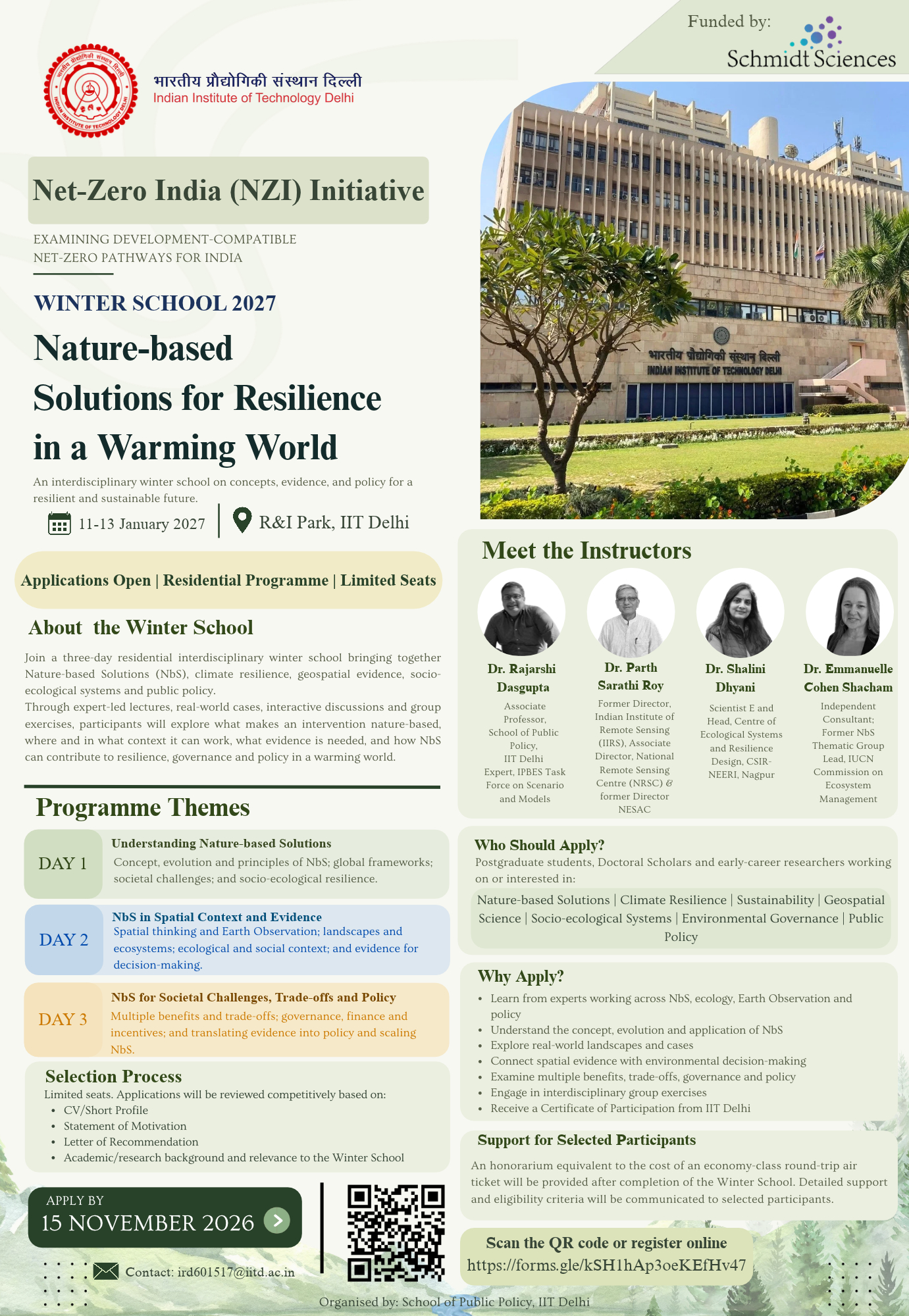
Applications Open
IIT Delhi, in collaboration with Schmidt Sciences under the Research Frontier Networks (RFN)programme as part of the Net-Zero India (NZI) Initiative, invites applications for a three-day residential interdisciplinary Winter School on Nature-based Solutions (NbS) , bringing together perspectives from climate change, ecology, geospatial science, socio-ecological systems and public policy to explore NbS and their role in addressing interconnected environmental and societal challenges.The programme will explore NbS concepts, evolution and principles; global frameworks and societal challenges; spatial thinking and Earth Observation; landscapes, ecosystems and socio-ecological contexts; evidence-based decision-making; and the multiple benefits, trade-offs, governance, finance, policy and scaling of NbS.
The Winter School is open to postgraduate students, doctoral scholars, and early-career researchers working in or interested in NbS, climate resilience, sustainability, geospatial technologies, socio-ecological systems, and public policy. Seats are limited, and only shortlisted candidates will be invited to participate. Refer to the link for more information.
For more information: Click here
-
Olivia Ruhil, first year PhD student at the School of Public Policy with long standing interests in AI and Governance, has been invited to speak at an upcoming panel series hosted by the Indigenous Studies Discussion Group, University of Cambridge.
She will speak on "From Mistranslation to Dispossession: Culture, Land, and Algorithmic Power in India", based on her work. Please read more about the panel here (hyperlink to:
https://isdgcambridge.wixsite.com/isdg/event-details/part-ii-from-mistranslation-to-dispossession-culture-land-and-algorithmic-power-in-india)
Olivia's talk is scheduled for 24 June 2026 at 13.00 - 14.30 BST (17.30 - 19:00 IST). To attend the talk, please register at https://events.teams.microsoft.com/event/d686c52a-00ac-4895-baba-a879533ed277@49a50445-bdfa-4b79-ade3-547b4f3986e9 -
IIT Delhi researchers from the School of Public Policy have made a significant contribution to a multi-institutional report titled, ‘India's Climate and Energy Frontiers (ICEF)’ that brings together insights from over 350 researchers across institutions, including several IITs, IISc etc.
This report represents a coordinated effort to highlight India-specific transition challenges while advancing solutions that are grounded in the country's socio-economic and institutional context.
As part of this effort, Prof. Kaveri Iychettira, Dr. Dwarkeshwar Dutt, Ms. Medhavi Sandhani, and Prof. Ambuj Sagar, have contributed a chapter titled “Climate Transition Pathways” to the report by Schmidt Sciences. The chapter examines some systemic and socio-economic dimensions of India's energy transition.
The chapter emphasizes that the energy transition extends beyond technological change and is deeply intertwined with social and economic systems. It identifies key limitations in many current approaches, including the narrow focus of conventional planning on technical solutions, the lack of suitable India-specific and integrated modeling frameworks, and the limited incorporation of behavioral, qualitative, and uncertainty-related factors. It further highlights critical socio-economic risks associated with the transition, such as impacts on coal-dependent regions, food security concerns linked to biofuel expansion, and land-use conflicts arising from renewable energy deployment.
To address these gaps, IIT Delhi researchers outline the need for next-generation, interdisciplinary modelling approaches that are better tailored to India's context.
“These recommendations include the use of advanced methods such as agent-based modelling, incorporation of diverse data sources, and enhanced capability to assess urbanization trends, regional employment shifts, and localized economic impacts of national policies,” Prof. Kaveri Iychettira, School of Public Policy, said.
The chapter also underscores the importance of strengthened collaboration across academia, industry, and government to support informed and inclusive policymaking. This chapter paves the way for an exciting research venture led by IIT Delhi, called the Net Zero India Project. A short explainer video on the project is available here: https://youtu.be/tjk2kSrdF-Q
In addition to Climate Transition Pathways, the ICEF report identifies six other priority research frontiers, including key energy technologies, climate finance modelling, land-based carbon sequestration, water and ocean sciences, built environment, and resilient cities.
-
IIT Delhi is collaborating with Schmidt Sciences under the Research Frontier Networks (RFN) program as part of the Net Zero India Project. With Schmidt Sciences' support, IIT Delhi is launching an open call for collaborative research to support India’s transition to achieving our net-zero emissions target by 2070.
About the Net Zero India Project
The objective of the Net Zero India project is to examine diverse spatially-resolved technological pathways for achieving net-zero emissions by 2070, and implications of these pathways on developmental outcomes such as employment, health (impacts of air pollution), energy access, equity, and capital allocation; and on sustainability outcomes such as land and water implications, and biodiversity across India. The project is led by IIT Delhi’s School of Public Policy and supported by Prayas (Energy Group) and Princeton University’s Andlinger Center for Energy and Environment.
We envision that this 3-year project will make the following unique contributions to scientific knowledge on the energy transition in India: (i) a combined focus on both developmental and sustainability outcomes of mitigation pathways for net zero GHG emissions, both spatially resolved until 2070, (ii) developing and combining new qualitative and quantitative methodologies, including a new approach to spatial mapping of energy technologies based on socio-economic considerations, to produce new insights (iii) transparent and open access to all modelling tools and data used in the study.
Research Frontier Networks by Schmidt Sciences
The Schmidt Sciences Climate Center is funding Research Frontier Networks (RFNs), designed to cultivate regional talent and develop context-specific tools (e.g., regional databases, energy models, dashboards) that advance earth system research and inform energy and carbon transition pathways. Each RFN serves as an interdisciplinary, cross-sector research hub where academic institutes, research scientists, industry experts, and government representatives collaborate to address global climate challenges with solutions tailored to local needs. The RFN model targets national and sub-national scale research in the Global South, beginning in India with IT Delhi as one hub, and expanding to other countries over time.
Research Frontiers Networks (RFNs) seek to build indigenous expertise and support the development of data and models that reflect the specific economic, social, and resource contexts of the Global South – contexts that are distinct from those of developed economies where most currently existing tools and models are developed.
IIT Delhi’s Open Calls for Collaboration under RFNs
Through the open calls for collaboration, funded by Schmidt Sciences, the IIT Delhi NZI team aims to identify and address emergent capacity deficits across several thematic areas of the Net Zero India (NZI) project. In this round, we release four calls for collaboration during the period July 2026 to May 2027, along the following themes: each theme is described in detail in the corresponding links below.
- Modelling Employment Shifts in India's Energy Transition. Details here.
- Linking High-Resolution Energy Infrastructure Pathways to Air Pollution and Mortality Outcomes in India's Net-Zero Transition. Details here.
- Modelling India's Forest Carbon through Dynamic, Spatial, and Integrated Modelling Approaches. Details here.
- Water-Food-Energy (WFE) Nexus Modelling for Development-Compatible Net-Zero Pathways in India. Details here.
Remuneration terms
S. No
Applicant type
Honorarium per month
1
Foreign PhD students or Postdocs
Upto USD 2500 per month
2
Students and Young Researchers from India. (RAs/PhDs/Postdocs)
Upto INR 100,000 per month
The honorarium is intended to compensate for living expenses while on the assignment in India.
-
Air tickets will be bought by IIT Delhi for one round trip travel.
-
A share of the honorarium will be paid after submission of selected deliverables.
Instructions for Applying
Click here to submit a 2-3 page research plan, a CV, and other details regarding your application.
Eligible applicants should be associated with an academic or not-for-profit organisation or NGO (non-governmental) of think-tanks and will need their supervisor's or institution's permission to work on the open call. Applicants will be assessed by a selection committee, based on their prior work and publications in the theme area and of the group they are associated with.
Important Dates
- Application deadline – 15th April 2026
- Selection of open call – 15th May 2026
Contact Information
In case of any query, you may contact Ms. Ashwini Mudgal (ashwinim.cstaff@iitd.ac.in) with cc to Dr. Kaveri Iychettira (Kaveri@iitd.ac.in) and Dr. Ekta Baranwal (ekta1988.cstaff@iitd.ac.in)
-
Title: Climate change adaptation through a justice lensSpeaker: Dr. Susanne Hanger-Kopp, Senior Research Scholar, The International Institute for Applied Systems Analysis (IIASA)Date: 11 February, 2026 (Wednesday)Time: 3:30 pmVenue: Room LH 213, IIT Delhi
Abstract:
Drawing on five years of work at IIASA, this seminar introduces the Applied Justice Taxonomy and Assessment Framework (AJUST) for assessing justice in climate change adaptation. Susanne Hanger-Kopp will explain the framework’s purpose, core concepts, and limitations, and show how it can support transparent, policy-relevant assessments of several justice-relevant dimensions of adaptation. She will then share insights from recent and ongoing projects applying AJUST in several European contexts, illustrating how justice considerations can be integrated into adaptation planning and evaluation, and where trade-offs and blind spots may arise. The seminar concludes with an open discussion on how justice frameworks can be strengthened and adapted across contexts, including opportunities for mutual learning with adaptation work in India.Bio:
Susanne Hanger-Kopp is part of the Equity and Justice (EQU) Research Group of the IIASA Population and Just Societies Program. She has 15 years of research and teaching experience in the areas of climate change adaptation and disaster risk management and has in parallel also worked on the energy transition. At IIASA, she has a leading role in developing the IIASA/EQU justice framework, which is instrumental in promoting comprehensive justice assessment in research and policy.Her analytical focus lies on governance and institutional development, but she also has experience with behavioral approaches. Most importantly, she is a knowledge integrator, designing and facilitating inter- and transdisciplinary research projects. For this purpose, she is invested in developing and promoting qualitative systems mapping as an indispensable tool to support systems thinking across disciplines, sectors, and subject matters.Hanger-Kopp has been chapter lead author for the Global Assessment Report for Disaster Risk Reduction 2022, and Lead Author for the Austrian Panel on Climate Change (APCC) Assessment Report on Climate Change in Austria (AAR2).Hanger-Kopp received her PhD from the Department of Environmental Systems Science at ETH Zurich, where she is currently a lecturer in the Climate Policy Lab. -
Title: The Evolutionary Boundaries and Business-Economic Dynamics of the "New" Space Economy
Speaker: Prof. Anthony P. D'Costa, Honorary Professorial Fellow, University of Melbourne, Australia
Date: 28 January 2026Time: 2.30 pmVenue: Room 510, Academic Complex (West)Abstract:The lunar landing by ISRO with Chandrayaan 3 in 2023 and the bringing back of a carbon-rich sample also in 2023 from Bennu, an asteroid that is 4.5 billion years old by NASA are recent examples of space projects undertaken by governments in search for scientific that also promises benefits for humanity. Less known are the subtle yet visible shifts taking place in the wider space sector with private business participation, thus giving rise to a "new" space economy (NSE). There is considerable research on the dynamics of different industries and sectors analyzing the technological, economic, business, institutional, and policy dimensions. How relevant are these for NSE? In this exploratory work, informed by the recently published The Oxford Handbook of the New Space Economy, https://global.oup.com/academic/product/the-oxford-handbook-of-the-new-space-economy-9780198881049?cc=it&lang=en#.
This presentation briefly addresses first, what is NSE, second, identifies and disaggregates some of the key forces behind NSE and its growing importance to the economy, and third, offers a basic understanding of the anticipated social and economic development implications of the wider evolving space economy. It concludes with some ethical dilemmas associated with extraterrestrial activities in outer space.
Speaker Bio:Anthony P. D'Costa is an Honorary Professorial Fellow, University of Melbourne. He has taught at the University of Washington, National University of Singapore, Copenhagen Business School, University of Melbourne, and the University of Alabama in Huntsville. He has fourteen books to his credit and is widely published in the areas of the political economy of development in India and East Asian industrialization, globalization, and economic development. He has been a recipient of numerous fellowships, including Fulbright-Hays; American Institute of Indian Studies; Abe of the Japan Foundation; UNU-WIDER, Helsinki; Korea Foundation; and POSCO at the East West Center, Honolulu.
His most recent publication is The Oxford Handbook of the New Space Economy (2025), while his 14th book Indian Business, Economic Development, and the Jobs Dilemma in the Twenty-first Century will be also published by Oxford University Press in 2026 -
Course Number: SPV 399
Course Title: Special Module in Policy Studies
Instructor: Prof. Sanjay Mitra and Prof. Upasna Sharma
Course Description:
This course introduces undergraduates to elements of policy-making and design that lead to policy success through eight real world case studies in the areas of electricity, decentralized planning, literacy, sanitation, nutrition (mid-day-meal), governance (self help groups), employment guarantee scheme, and counter-insurgency, in states in India. Through the cases the students learn about, what becomes a matter of public policy? Who or what puts an issue on the government’s institutional agenda? What design related and other factors drive the success of public policies? How do policy makers interact with the stakeholders? What role do global factors play? What could be some unintended consequences of public policies? Upon completion, students will be able to critically examine policy decisions and analyse policy documents. Though mostly practice oriented, theoretical inputs will be appropriately woven in for a holistic appreciation. This course will be an excellent introduction to advanced courses in specific areas of public policy. There will be a final exam consisting of short answer questions and a viva to test in-depth understanding (of a specific topic). -
Course Number: SPL 724
Course Title: Electricity reforms in a renewables era
Instructor: Prof Sanjay Mitra and Prof Kaveri Iychettira
Course Description:
What strategies will lead to an electricity sector transition which suits the objectives or needs of diverse actors such as generators, consumers, political actors, and distribution companies? As its name suggests, it will start by covering the need for and the scope of reforms in the electricity sector in various states in India and several countries across the world. We will then talk about the impact of the transition to renewables and its impact on efficiency, emissions, affordability and access. There are no pre-requisites. While we will use basic tools and concepts from electrical engineering, economics and public policy, these will be adequately covered in class. With hands-on case studies, problem sets inspired by real-life, and engaging readings, this course will equip the students with tools to analyse and understand this technology-dominant sector from economic, social and policy lenses. We will have mid-term and final exams and a few assignments. Students will learn to analyze and compare energy transition trajectories across geographies.
-
Prof. Kaveri Iychettira and Prof. Ambuj Sagar, in collaboration with Schmidt Sciences, organized a conference “Catalyzing energy transition pathways in India for development and sustainability” from 20th to 22nd January 2025. The conference report and proceeding can be downloaded from the following link
Video proceedings:
-
One of our MPP students, Olivia Ruhil has got her blog piece "Justice in the age of algorithms: can AI weigh morality?" accepted in the Curmudgeon’s Corner of Springer Nature’s AI & Society journal.
Read more about her work here
-
The School of Public Policy is offering the following new courses during the upcoming semester (January - June, 2025).
The details of these courses, please click here
-
Prof Kaveri Iychettira and Prof. Rajarshi Dasgupta received the Giving Green Fund to investigate development-compatible pathways for achieving net-zero emissions in India by 2070. In collaboration with Prayas Energy Group and Princeton University, the consortium aims to inform the central and state governments, private sector organizations, and communities about what it takes to reach economy-wide net-zero emissions and its implications on development and sustainability outcomes.
More details: https://www.givinggreen.earth/mitigation-research/prayas-and-iit-delhi
-
Speaker: Dr. Shyama Ramani, Friend In Need India Trust and SITE4Sustainability
Title: On steering a behavioural transition from open defecation to toilet usage for sustainability
Date: 6 Nov 2024
Time: 12:00 pm
Venue: LH 510
Abstract:
When toilets are introduced as a niche innovation in communities where the dominant social norm is Open Defacation (OD), under what circumstances are there tipping points directed towards OD Free (ODF) state?
To answer this question, a two-step methodology is applied. First, a simple evolutionary game theoretic model of social norms is developed. This game setting is inspired by the seminal works of Fishbein (1967) and Fishbein and Ajzen (1975) in social-psychology. Their Theory of Reasoned Action and Planned Behavior (TRA) offers a conceptual framework of the links between pre-existing attitudes and behavioral intentions to predict behavior. Second, simulations are conducted to identify factors influencing the tipping point towards universal toilet usage. The findings contribute to understanding tipping points for social norm transitions. The study shows how village characteristics, existing social norms, sanitation programs' features, and the evolving confidence of community members in using toilets drive the dynamics. Some villages transition to ODF, while others stagnate or even revert to OD. This highlights the importance of targeted interventions to influence tipping dynamics and achieve sustainable ODF communities.
-
Speaker: Dr. Pooja Prasad, School of Public Policy, IIT Delhi
Title: Water security in semi-arid regions: Are public investments in irrigation leading to climate resilience in agriculture?Date: 23 Oct 2024Time: 12:00 pmVenue: LH 510Abstract:
In this talk, I first motivate why its important to study the semi-arid rainfed regions and how changing monsoon patterns and increasing dry spells impact farmer vulnerability. I then analyze public investments made for climate resilient agriculture, the majority of which include investments in horticulture, micro irrigation and farm ponds. Using a socio-hydrological approach, I argue that the current investments which are made at farm-scale may appear to address vulnerability of the beneficiary farmer, but at the systems scale, they worsen the impact of dry spells and droughts for the majority of smallholder farmers. I call for the need to re-imagine ways in which climate resilience in agriculture may be operationalized, with principles of equity and justice at its core. I will end with some recent work on this and share my research vision for the next 3-5 years.
Bio:
Pooja Prasad is an assistant professor in the School of Public Policy at IIT Delhi. Her research aims to influence public investments in land and water management to support livelihood security and sustainability in highly uncertain water-stressed regions of South Asia and Africa. Pooja uses a systems lens and a socio-hydrological approach to capture interactions within and between social and natural systems. Prior to joining IIT Delhi, Pooja was a postdoctoral researcher at IHE Delft Institute for Water Education in the Netherlands. Pooja has a PhD in Technology and Development from CTARA IIT Bombay. She has a
Masters’ degree from Stanford University and a B.Tech. from IIT Bombay. -
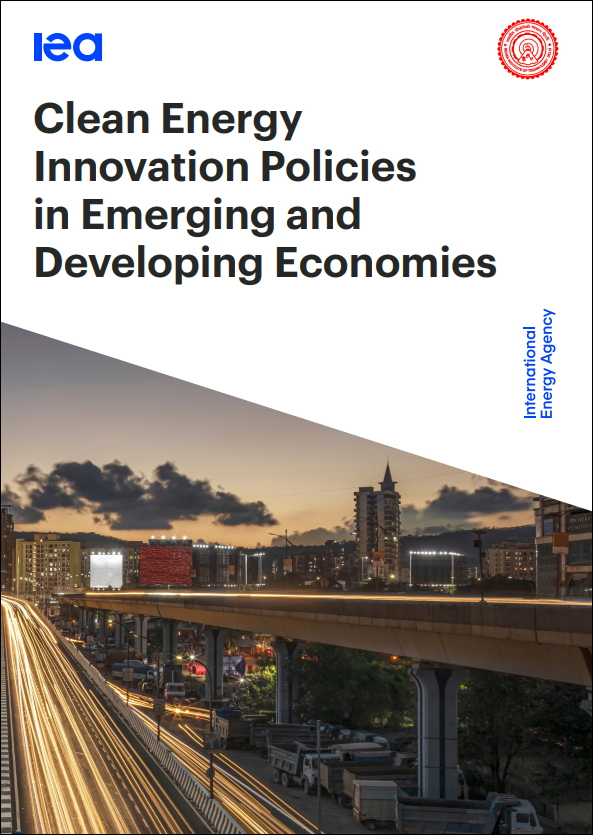
IIT Delhi and the International Energy Agency (IEA) have recently released a joint report titled "Clean Energy Innovation Policies in Emerging and Developing Economies" that has 11 new case studies of national experiences with policy development and implementation in support of energy innovation in emerging and developing countries.
These studies reveal a number of key findings and insights for governments, intergovernmental bodies and other partners to work on effective policy packages to strengthen clean energy innovation ecosystems in emerging and developing economies, which will help them address the climate challenge.
Read the full report here: https://shorturl.at/0fCrL
-
Title: Climate Science to Inform Adaptation and Policy
Speaker: Prof. Krishna Achyuta Rao, Centre for Atmospheric Sciences, IIT_DDate: 4 September 2024Time: 12:00 pmVenue: LH 313.1
Abstract:
Climate Science has been focused on understanding the behavior of the climate system. Climate models have been a very useful tool in non only understanding how the climate system works but also to project how it can change in the future. Models and observations together can also tell us how natural variations occur. Through attribution techniques, we can now quantify the natural and human contributions to changes in the long-term climate as well as specific extreme weather events.
Much work exists on the projections of future climate and the resulting impacts on various sectors such as agriculture, health, water, etc. Most of this has in the past focused on long-term (multiple decades to a century) changes (and their impacts) that depend on future emissions that are highly uncertain. Lately, models are being used to predict the climate and its variations on "actionable" time-scales. Forecasts a season ahead or for the next decade can be very useful in making various decisions. However, our capabilities in this are still primitive and much work needs to be done.
My work in climate science has been in these areas. Through examples of my past and ongoing research, I will touch upon the possibilities for using science to inform adaptation and policy studies in general.
Bio:
Krishna AchutaRao joined the Centre for Atmospheric Sciences in 2007 and worked extensively on the modelling of Regional Climate Change, Weather and Climate Extremes, Climate Change Detection and Attribution, Climate Modeling, Climate Variability, Climate Model Validation and Diagnosis, Ocean Heat Content, Sea-level Rise, UV CDAT. Currently he serves as the Dean (Faculty). Please read more about his publications and projects by visiting the link below:
https://web.iitd.ac.in/~akrishna/ -
Title: Initiatives to Support India's Energy Sector
Speaker: Dr. Abhishek Malhotra, Young Professional - World Bank
Date: 2 Aug 2024Time: 5:00 - 6:30 pmVenue: LHC 313.1Abstract:
The World Bank is one of the largest multilateral development banks and a key institution in the global sustainable development landscape, with a significant focus on transforming energy sectors in emerging economies. This talk provide an overview of the World Bank's initiatives in India's energy sector, highlighting its strategic interventions to facilitate the country's progress toward energy security and sustainability. As India strives to meet its growing energy demands and environmental goals, the World Bank has been instrumental in supporting key projects that enhance power infrastructure, integrate renewable energy sources, and promote energy efficiency. This talk will provide an overview of the World Bank's programs that include financing, capacity building, and support for deployment of innovative technologies to advance India's energy landscape by helping improve energy access, reducing carbon emissions, and strengthening and expanding the energy sector."Bio:
Abhishek Malhotra is a Young Professional in the Energy and Extractives Practice in South Asia at the World Bank. Prior to this, an Assistant Professor at the School of Public Policy at IIT Delhi and a Postdoctoral Research Fellow with the Belfer Center's Science, Technology and Public Policy Program. His areas of interest include energy efficiency, industrial decarbonization, and capacity building for energy technology innovation and low-carbon development. -
The School of Public Policy is offering new courses during the upcoming semester (July-December 2024).
For details on the full set of new courses, please Click here.
-
We are delighted to invite you to a talk by Dr.Thaisa Comelli from the Department of Risk and Disaster Reduction at University College London (UCL).
Title: Radical Imagination for better cities: How can ‘envisioning the future’ with inclusion help reduce disaster risk?Speaker: Dr.Thaisa Comelli
Date: 22 July 2024, Monday
Time: 12- 1:30 pm
Venue: LHC 212
Abstract:
How can ‘envisioning the future’ with inclusion help reduce disaster risk? Phenomena such as rapid urbanisation and climate change are driving significant changes in our built and natural environments. This presents us with a small but powerful window of opportunity to act now to mitigate or amplify future disaster risk. Relying solely on past experience and merely reacting to hazard events is insufficient. Resilient cities must be capable of long-term, forward-looking planning to ensure that current and future generations can live fulfilling lives in harmony with nature.
This talk will discuss the advantages of ‘Normative Future Visioning’ (Pelling et al., 2023; Comelli et al., 2024) for urban development planning aimed at inclusive and equitable disaster risk reduction. Drawing on the experience of the global Tomorrow’s Cities Hub, this futures approach seeks to surface values and aspirations from diverse social perspectives, and combines methods from various disciplines to find intersections between desirable, plausible, and probable futures.
This session will:
1. Explain the theoretical and methodological foundations of Normative Future Visioning and its usefulness for interdisciplinary disaster risk reduction practice in cities.
2. Demonstrate the application of the approach in real-world contexts in the global south.
3. Discuss how similar approaches can be used to reduce disaster risk and climate change vulnerability in India, particularly in Delhi. -
Title: The El Niño Southern Oscillation, Forecasting, and Situated KnowledgeSpeaker: Dr George Adamson
Date and Time: April 4th, 12-1:30 pm
Venue: LH 212
Abstract:The El Niño Southern Oscillation is often given as a key explanatory factor for extreme or unexpected weather across the tropics, including India. The declaration of an El Niño event can provoke disaster managers to prepare mitigation in advance of expected hazards, and can release international aid money through forecast-based-financing. Yet the phenomenon is more difficult to define than is often presented, and there have been notable forecasting failures. Moreover, the definition of El Niño that is commonly used is in fact a national definition produced by the National Oceanic and Atmospheric Administration in the US, and is not always suitable for El Niño-related impacts elsewhere in the world. This presentation will outline the history of the discovery of the phenomenon and its codification through forecasts and indices. Using theories from Science and Technology Studies I will argue that there are in fact multiple El Niños, and that the production of knowledge around the phenomenon should be considered as being situated in specific contexts. Appreciating this is vital for policymaking.Bio:
George is a Reader in Climate & Society at King's College London. Coming from a multidisciplinary background, his research examines how climate knowledge is constructed through science, governing institutions and culture, and how these different understandings of climate interrelate. His work is primarily based in India and the UK, with a particular focus on the El Niño Southern Oscillation.